5 min read
From Strategy Idea to Research Evidence
A look at the research workflow we have been building: explicit plans, saved experiments, evidence checks and a clear next step, with the Algo Agent or your own MCP client.
A strategy idea is the beginning of an investigation. The useful questions come afterward: what did you test, what had you already seen, which changes helped, and what evidence would justify continuing?
Over the past several weeks, we have been improving how that investigation works in Algo Trade Analytics. The work spans the Algo Agent, the MCP tools, Case Studies and the new Research Overview. Together, these changes give research a clearer path from an initial hypothesis to recorded experiments and a decision about the next step.
One workflow, two ways to work
You can research inside Algo Lab with the Algo Agent, or connect your own AI client through MCP. The internal agent supports a multi-step research loop within its configured limits. With MCP, your external client drives the reasoning and calls the platform's research tools.
Both routes can work with a saved Case Study, research runs, candidate versions and evidence records. A conversation can move on; the study keeps the investigation available for review.
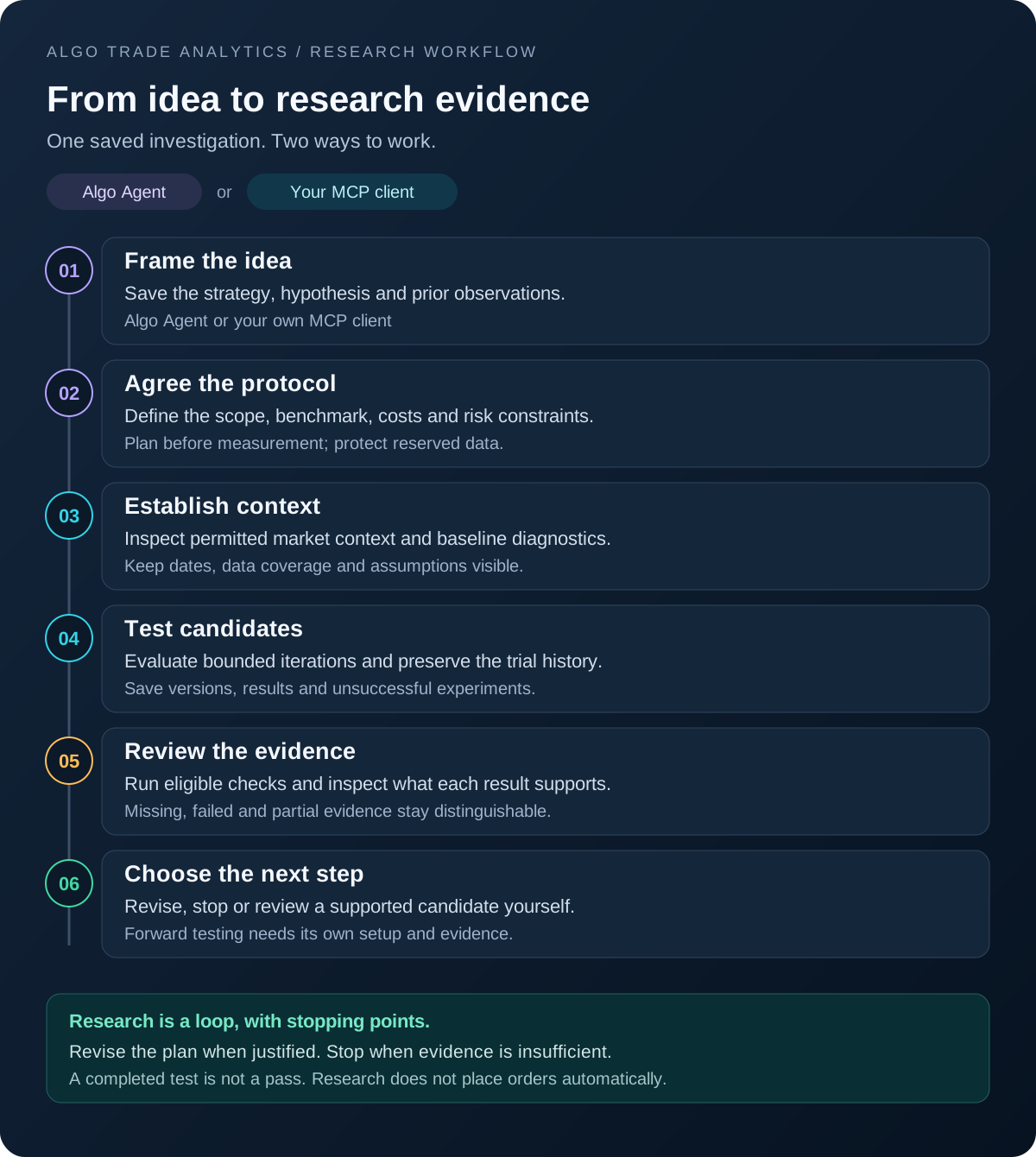
Open the full-size workflow infographic.
Start with a plan you can check later
Before more testing, establish what the strategy is trying to do and where it will be tested. Record the hypothesis, market, timeframe, costs, risk constraints and experiment protocol. Review existing research and disclose prior observations that may have influenced the idea.
That history matters. A fresh run or a different account does not make previously inspected market data unseen. The workflow tracks recorded exposure and uses declarations about prior research to help distinguish development work from eligible confirmation work. Those declarations still depend on an honest account of observations made outside the platform.
A plan also makes a disappointing result useful: it gives you something specific to compare the experiment against, instead of changing the question after seeing the answer.
Give each experiment a context
A return number needs its dates, costs, configuration and comparison. Market-context and baseline diagnostics help describe the conditions behind a test. Candidate evaluation can then compare a proposed strategy against a benchmark under the recorded scope.
The research tools preserve versions, trials and evidence, including results that do not support the idea. Repeated experiments remain part of the investigation; creating a new run does not erase the search history that matters to a later claim.
Longer research operations use background jobs, so the client can check their status and retrieve the recorded result. The workflow also has budget and stopping controls. A job completing means a result is available to inspect; it does not mean the strategy passed its checks.
Let the evidence determine the next step
Research can include statistical checks, stress tests, walk-forward analysis, cost sensitivity and other diagnostics. Which checks can run, and what they establish, depends on the protocol, available data and earlier gate results. These are evidence requirements, not a menu of badges to collect in any order.
The platform separates a saved analysis from an interpretable conclusion, and a passing result from a failed or missing one. Scope, data coverage and runtime context matter when deciding whether evidence supports the current candidate. A partial result should remain partial.
Sometimes the next step is another bounded experiment. Sometimes it is to revise the hypothesis, ask for a decision or stop. More testing is useful only when it answers a justified question.
See where to continue
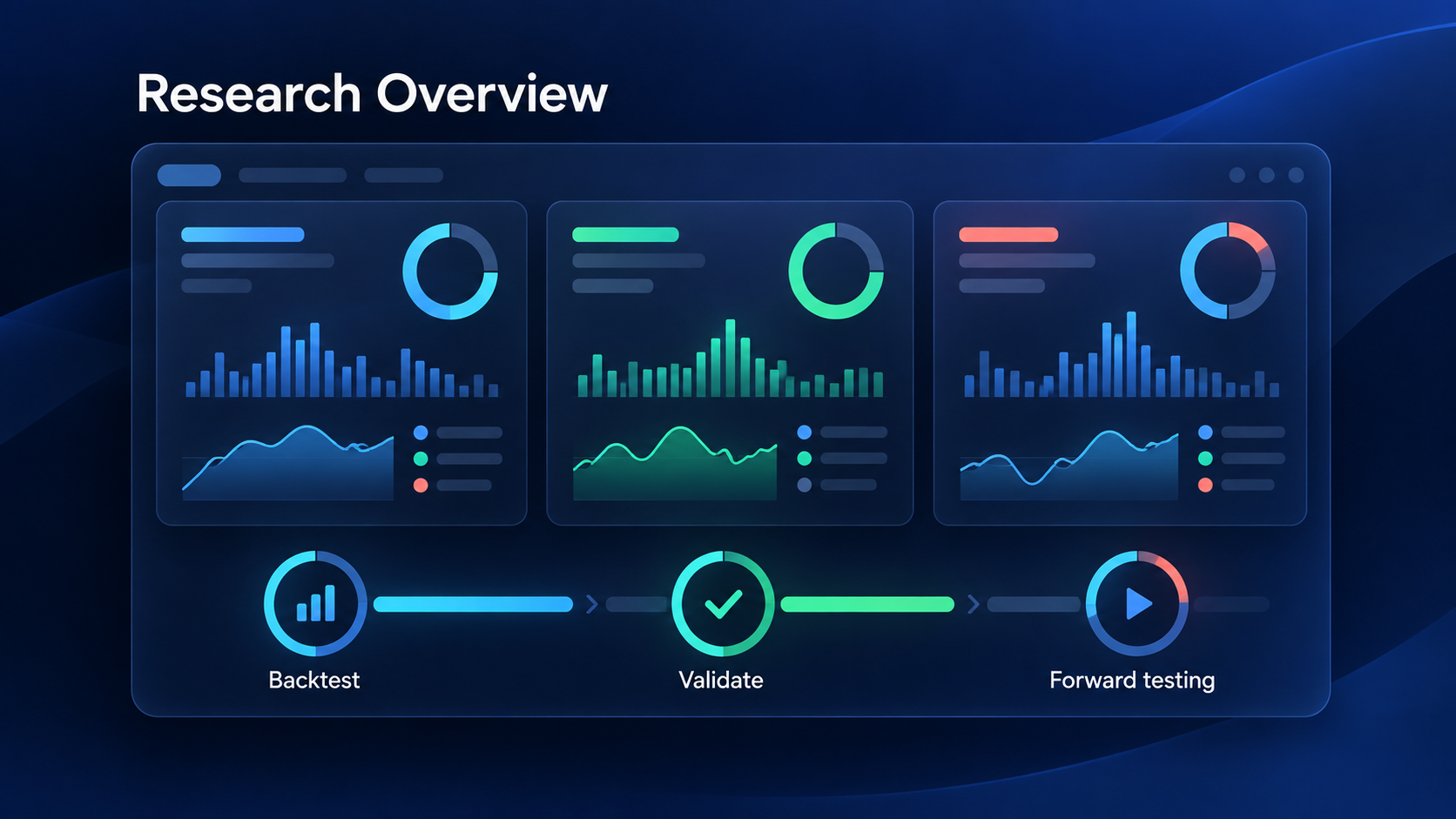
Research Overview brings the studies together. Each card shows a saved backtest, the research journey, versions and trials, and the checks that need attention. You can filter the list, inspect failed or incomplete checks, and open the report behind a displayed result.
An expanded gate explains its purpose and offers a next step. Continue with Algo Agent opens a fresh conversation with a draft tied to that study, run and gate. You review it before sending. Copy request for agent gives you a request to take into your own research client. Opening the chat does not run a test.
The Hub provides a compact route back into recent studies. The detailed investigation remains in Research Overview and Algo Lab.
Keep the decision in your hands
A candidate staged by the Algo Agent is presented for review before you accept its source changes. Research results do not automatically place brokerage orders. Historical checks and later forward testing answer different questions; neither removes market risk.
The goal of this workflow is to make the reasoning, experiments and limits easier to inspect. You should be able to explain why a candidate deserves another test, why a result is inconclusive, or why an investigation should end.
Read the research workflow guide for the complete flow and decision points. Or open Research Overview to continue a saved study or start your first investigation.